
How Temperature Affects Sag in Overhead Conductors
Introduction – the Core Gap
When most people look at a power line, they see a span of wires and a couple of poles and think little of it. In reality, that span is part of a dynamic system that is constantly changing with environmental and electrical conditions. Most overhead conductors are made from metals like aluminum and steel, which expand as heat increases. As temperature rises and falls, conductor sag and tension change with it.
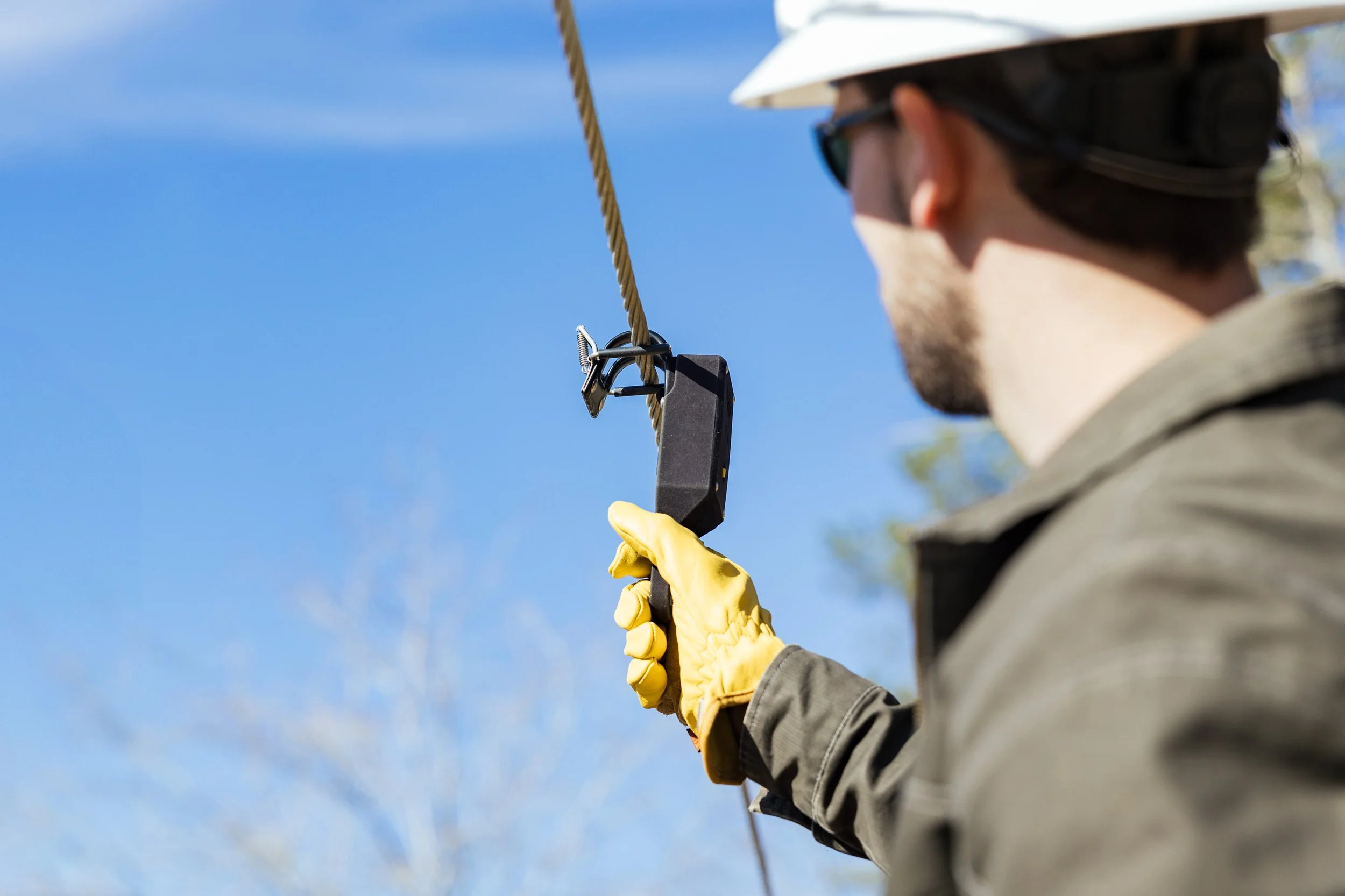
The WaveTimer by Vulcan Line Tools measures conductor temperature.
Temperature in this context is two-fold. It includes both the ambient temperature of the surrounding environment and the temperature of the conductor itself caused by electrical load. When spans are engineered, they are designed around compliance standards that account for worst-case conductor temperatures. In practice, however, field measurements during construction and maintenance are often based only on ambient temperature readings. This creates a mismatch between assumed and actual conductor conditions, leaving spans vulnerable to excessive sagging, increased pole loading, clearance violations, and reduced long-term reliability. The following article describes how temperature affects sag in greater detail, why this is important, and the ways to mitigate the related risks.
What are Sag and Tension?
Sag is the vertical displacement of a conductor between support structures. Tension is the pulling force applied to the conductor as it spans between those structures. These two forces are directly related: as tension increases, sag decreases and vice versa.
Temperature, span length, loading conditions, conductor type, and age all influence this balance. That is why sag and tension are never truly fixed values, they continuously change as conditions in the field change.
How Temperature Actually Drives Sag
A primary contributor to changing sag and tension conditions is temperature. As conductors heat up, the metal physically expands and grows longer. This process is known as thermal expansion. Because the poles remain fixed, that additional length has nowhere to go but down, increasing sag while simultaneously reducing tension.
The coefficient of thermal expansion for aluminum is approximately 22.2 × 10⁻⁶/°C. Across a standard 500-foot ACSR Drake span, a 120°F temperature increase can cause approximately 6.4 inches of conductor length growth and roughly 4.7 feet of additional sag. Aluminum also has an expansion coefficient approximately 35% greater than copper, making modern aluminum conductors significantly more sensitive to temperature-driven sag than older copper infrastructure.
Older spans introduce an additional challenge through a phenomenon known as creep, where conductors permanently elongate over time under sustained mechanical tension. The effects of temperature-induced sag compound further in these aging systems.
Why This Becomes a Real-World Problem
Sag is a critical factor in overhead line design because it directly affects the safety, reliability, and long-term performance of a system. Excessive sag can create serious operational and public safety risks, including clearance violations and conductor contact with surrounding vegetation or infrastructure.
The following examples illustrate why sag management matters:
A conductor sagging beyond NESC minimum clearances creates direct safety and liability risks for the public, climbing crews, and the utility or telecom responsible for the system.
Between 2016 and 2020, electrical power networks caused approximately 19% of all U.S. wildfires. Conductor-to-vegetation contact driven by thermal sag remains one of the primary contributors.
The 2007 San Diego wildfires burned more than 200,000 acres and resulted in over $2 billion in settlements paid by SDG&E after power line failures contributed to the event.
For make-ready engineering and joint use work, clearance data captured during cool conditions may not accurately reflect summer operating conditions. Any loading analysis or engineering design built on inaccurate sag assumptions risks failing in the field.
When sag is not properly accounted for during construction or while evaluating existing spans, both conductor reliability and pole integrity suffer. For example, crews may tension a span aggressively during peak summer temperatures only for the conductor to contract significantly during winter, increasing loading forces on the poles and hardware. Properly measuring both conductor and ambient temperature helps avoid these scenarios before they become operational problems.
The Measurement Problem
Preventing these issues ultimately depends on effective measurement practices. While different sag measurement approaches each offer their own advantages and limitations, one critical factor often remains overlooked: conductor temperature itself.

A lineman performs a jerk-test with the WaveTimer.
Traditional methods such as stopwatch-based jerk tests frequently rely entirely on ambient temperature readings. As a result, the true conductor temperature, and therefore the actual sag and tension state of the span, is estimated rather than directly measured. This introduces unnecessary uncertainty into a process that directly impacts system safety and reliability.
Even when operators carefully account for ambient conditions, conductor temperature can still vary substantially depending on electrical load, solar heating, wind conditions, and whether the line is energized. In our own field work at Vulcan Line Tools, we have observed de-energized conductor temperatures can differ from ambient temperatures by as much as 15°F. When conductor temperature is not directly measured, these differences are completely missed.
The Solution
Fortunately, there are reliable methods for effectively measuring conductor temperature. Conductor thermometers, for example, can measure wire temperature when attached directly to a span. When paired with sag measurement practices such as jerk tests or scoping procedures, they improve construction accuracy and consistency.
At Vulcan Line Tools, we developed the WaveTimer to address this challenge directly. The handheld device uses infrared sensors to measure conductor temperature while simultaneously performing sag measurements on the line itself. Unlike standalone conductor thermometers, the WaveTimer combines temperature measurement and sag testing into a single workflow.
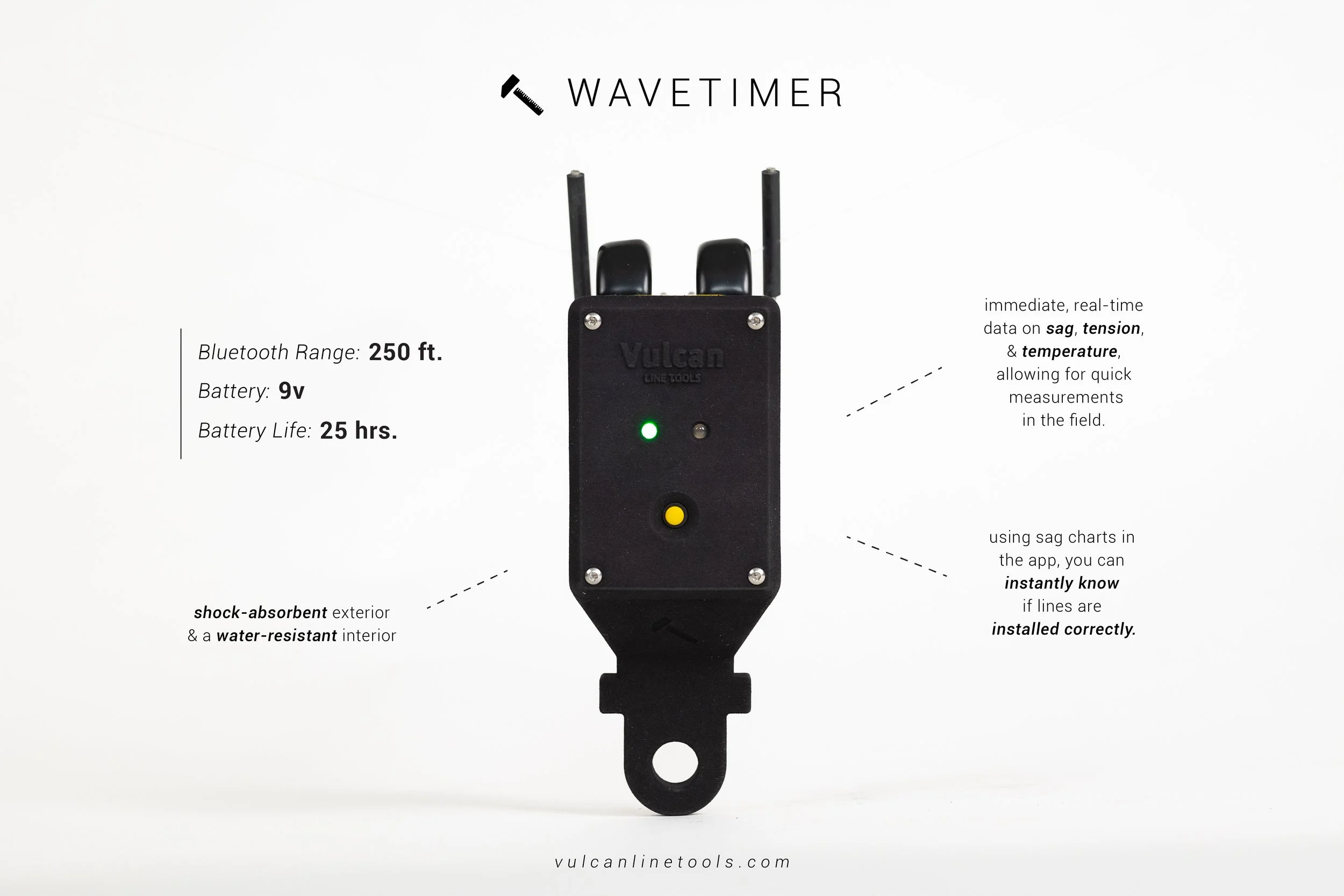
The WaveTimer’s Specifications.
The process is straightforward:
Users load utility sag charts into the device before use.
The device is attached to the conductor, where it measures conductor temperature directly.
The user jerks the line and waits for the sag measurement to populate in the Vulcan Line Tools mobile app.
Results can then be saved as a PDF report for documentation and future reference.
While the WaveTimer is our recommended solution, the broader point remains the same: accurately accounting for conductor temperature is essential during construction, maintenance, and evaluation of existing spans.
Conclusion
Overhead conductors are constantly responding to changing environmental and electrical conditions, making sag and tension management an ongoing operational challenge rather than a fixed design value. Accurately measuring conductor temperature is a critical part of building and maintaining safe, reliable infrastructure. Whether during initial construction or while evaluating existing spans, utilities and contractors need measurement methods that reflect real-world field conditions rather than assumptions alone.
For more information about relevant solutions, click here: