
What is a Joint Use Audit?
What is a Joint Use Audit?
“Joint use” is an industry term that refers to the shared use of utility poles by multiple entities. These entities range from electric utilities—who most often own the poles—to the telecom providers and cable operators who attach their strands to them. Managing this relationship and the associated infrastructure requires pole owners to understand who is attached to their poles, where attachments are located, and whether attachments meet clearance and safety standards.
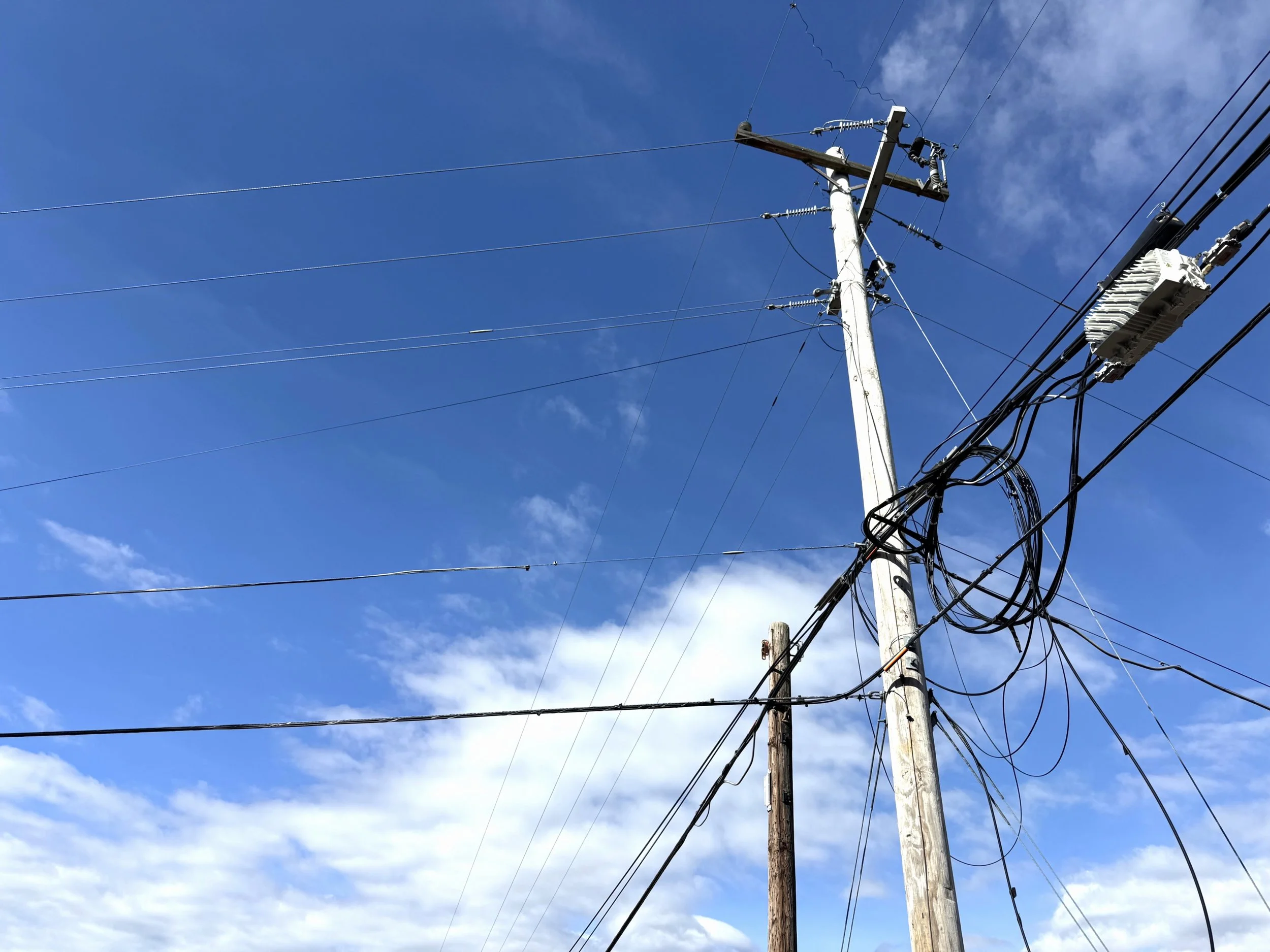
A power pole with multiple joint use attachments.
A joint use audit helps pole owners identify how many attachments each entity has to their poles, where these attachments are in their grid, and whether compliance risks and/or safety issues exist. Most joint use audits uncover unaccounted attachments (often 5–7% over a five-year interval), along with violations, transfers, and instances of double wood. The following article will cover why joint use audits are important, the solutions that exist to perform audits, and our unique approach at Vulcan Line Tools.
Why are Joint Use Audits Important?
There are roughly 180 million utility poles in the United States, and on a meaningful percentage of them, attachments exist that are unauthorized, out of compliance, or not properly accounted for in billing systems. This creates a persistent gap between recorded data and field reality, with financial, operational, and safety consequences.
This issue affects multiple stakeholders. Electric utilities, co-ops, and municipalities own the poles, while telecom, cable, and broadband providers attach to them. When data is inaccurate, pole owners lose revenue and take on compliance risk, while attachers experience delays during deployment. At scale, this becomes a system-wide visibility problem rather than a simple record-keeping issue.
Where Joint Use Audits Typically Breakdown
Joint use audits are conceptually straightforward—identify attachers, verify compliance, and reconcile records—but in practice, they are difficult to execute at scale.
Several constraints drive this:
Outdated or incomplete field data: Records often lag behind real-world conditions, especially in areas with frequent attachment activity.
Labor-intensive fieldwork: Traditional audits rely on two-person crews and specialized equipment, making them expensive and time-consuming.
Limited scalability: What works for a small system does not translate easily to cities, counties, or multi-state territories.
These challenges create a persistent gap between system records and field reality. Even when audits are performed, they are often periodic rather than continuous, allowing new discrepancies to accumulate over time. As broadband expansion accelerates, this gap becomes more difficult and costly to manage.
How Joint Use Audits are Typically Performed
There are several approaches used across the industry to perform joint use audits, each addressing different parts of the problem. These approaches vary in depth, cost, and scalability, and are often used in combination depending on the needs of the system.
Manual Field Inspections
The most traditional method involves field crews inspecting poles individually, identifying attachers, and documenting compliance issues. This approach is thorough but costly and difficult to scale.
Engineering-Led Audits
Some audits incorporate deeper engineering analysis, including structural assessments and pole loading evaluations. These provide a high level of detail but are time and resource-intensive.
Mobile or App-Based Tools
Newer approaches use mobile applications to streamline field collection, allowing smaller teams to capture attachment data more efficiently. These tools improve speed but still require utilities or contractors to staff and manage field operations.
Platform-Based Workflows
Administrative platforms help utilities manage attachment applications, track approvals, and maintain records. While effective for organizing data, they do not solve the challenge of collecting accurate field information and must be paired with an exceptional fielding approach.
Each method plays a role, but none fully addresses the combined challenges of data accuracy, cost, and scalability on their own.
Where Different Approaches Make Sense
Not every joint use audit requires the same level of detail or investment. The appropriate approach depends on scope, timing, and objectives.
Manual and engineering-led audits are best suited for targeted, high-detail assessments where full compliance validation is required.
Platform-based solutions support administrative workflows and long-term record management.
Mobile tools improve efficiency for teams with internal field resources.
For large systems or early-stage planning, however, these approaches can be difficult to apply consistently across an entire network. In these cases, utilities often need a way to quickly understand system-wide conditions before committing to more cumbersome, resource-intensive work. As a result, the most effective audits integrate the ideal components of each approach while minimizing their shortfalls.
Our Approach at VLT
Because no single method fully solves the challenges of joint use audits at scale, the most effective approach integrates the strengths of multiple methods while minimizing their shortcomings.
At Vulcan Line Tools, our process is built around capturing complete, system-wide field data efficiently, then extracting the information needed for joint use analysis.
We begin by collecting high-resolution 360° imagery across the entire network using vehicle-mounted camera paired with RTK-corrected GPS receiver.
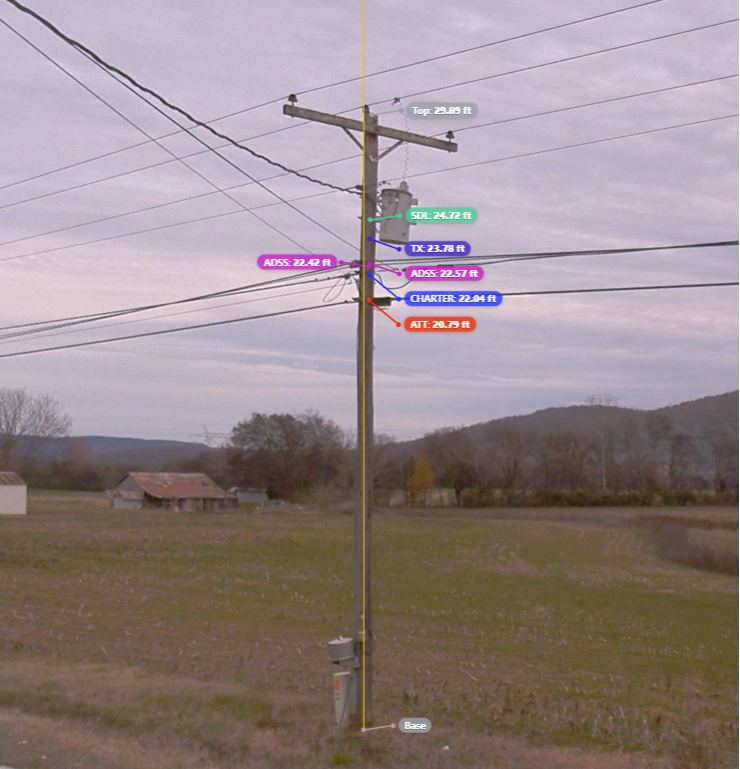
A pole with attachments labelled in Azmyth.
Once collected, this imagery is processed in our proprietary software Azmyth, where designers extract structured data from each pole.
This includes:
Triangulating pole locations
Measuring pole heights
Identifying attacher heights and ownership
Highlighting midspan context and evaluating field conditions
Organizing data into consistent, GIS-ready outputs
For areas that cannot be accessed by vehicle—such as poles located off-road, behind obstructions, or in dense terrain—we supplement collection using Azmyth On Foot. This allows fielders to capture the same type of measurable imagery manually, ensuring consistency across the dataset while eliminating gaps.
By combining scalable imagery collection with targeted manual capture, this approach provides:
System-wide visibility
Consistent, structured documentation
Reduced reliance on large field crews
The ability to scale across entire service territories
Rather than replacing traditional audits entirely, this method creates a practical foundation for understanding what exists on the pole, allowing utilities to bill attachers appropriately and apply more detailed analysis where it is most needed.
Conclusion
Joint use audits exist to answer a simple set of questions: who is attached, where those attachments exist, and whether they are compliant. Across millions of poles, however, those answers are often unclear due to gaps between recorded data and field reality.
Traditional audit methods provide depth but struggle with cost and scalability, while newer tools improve efficiency but still rely on internal resources or incomplete datasets. As broadband expansion continues and attachment activity increases, these limitations become more pronounced, making it harder for utilities to maintain accurate records and manage risk effectively.
The most effective approach is not to rely on a single method, but to combine scalable data collection with structured analysis to create a clear, system-wide understanding of the network. By closing the gap between what is recorded and what actually exists in the field, utilities can reduce revenue loss, improve compliance, and make more informed decisions about their infrastructure.
As the industry shifts toward greater visibility and faster decision-making, the ability to quickly and accurately understand what is on the pole is no longer optional.
Find more information about relevant solutions here: