
How the City of Bessemer More Than Doubled Its Joint Use Billing
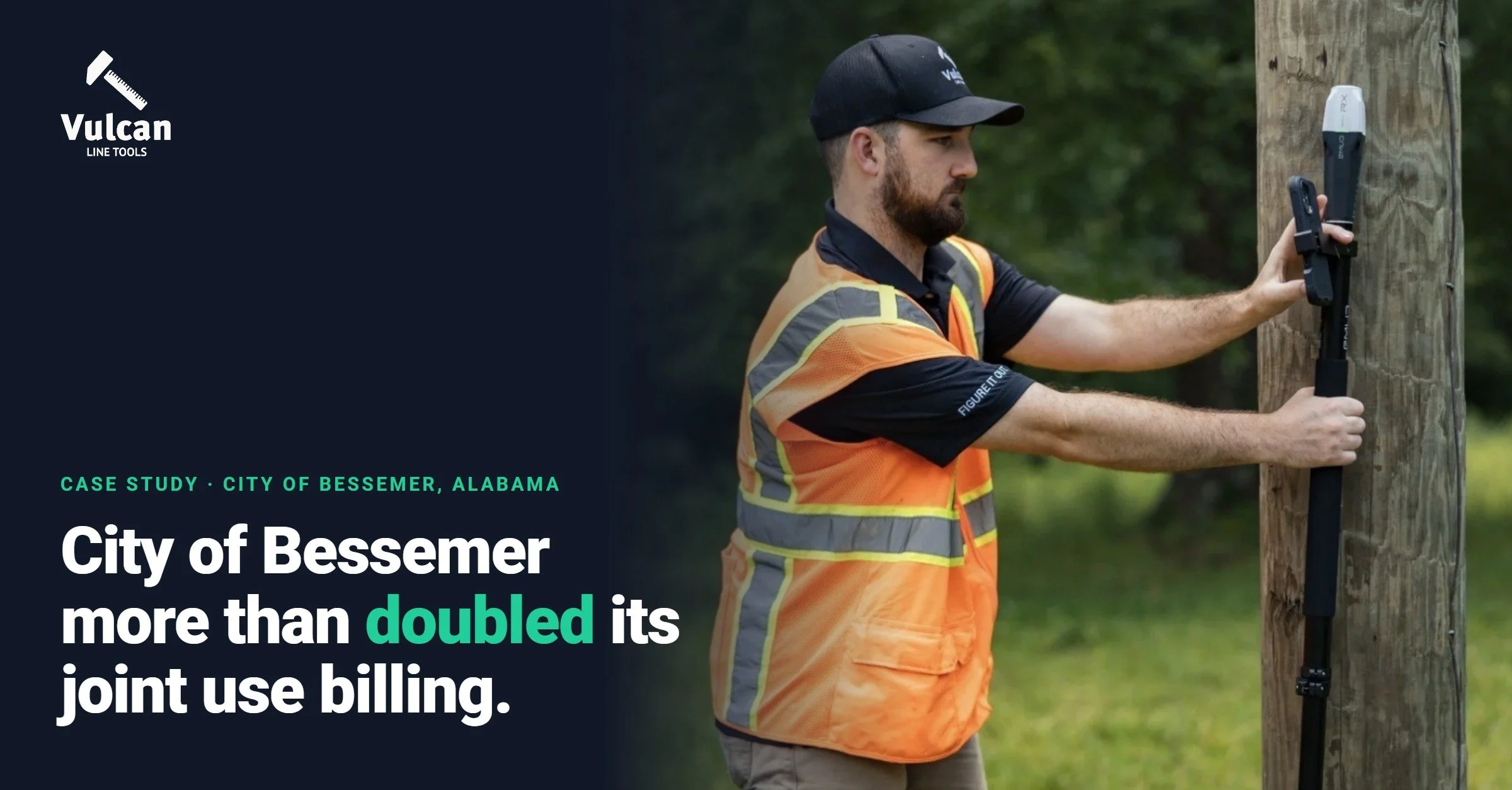
The City of Bessemer, AL just increased its annual joint use billing by 124%. Put simply, that means they can now charge the telecom companies who attach cables to their poles more than double the previous amount. This is thanks to the joint use audit we conducted for Bessemer Utilities (BU), the department that owns and operates the municipalities’ electric transmission and distribution systems. In performing this audit, we were able to identify and fill significant gaps in their joint use attachment records. We also advanced their network map from a static document to an interactive GIS database.
Below, we explain what a joint use audit is, why it is important, how we performed this one and the results we achieved.
Why joint use audits are important
Joint use audits matter because pole owners who rely on attacher-reported counts usually miss billable attachments, and an independent audit recovers that revenue with photo-backed records that hold up in disputes. But first let’s back up. These audits are meant to count the cables attached by different third-party communincation attachers on a power company’s poles. The pole owning entity and the attacher will establish a “joint use agreement” in which they set standards on how many cables will be attached, the condition they will be in, and so on. These “attachers” pay a fixed fee for each pole that they attach to.
Without regular audits, pole owners end up billing from whatever counts the attachers report. Over time, new attachments go unrecorded, and so does the revenue they should generate.
Why Bessemer needed an audit
BU was in exactly that position. No one was sure when the system had last been audited, if ever, and BU relied solely on the attachment records provided by the attaching companies. BU also lacked a complete inventory of its own assets. The result was unbilled revenue and records that lagged well behind modern industry standards.
Our approach: a three-step audit
Vulcan Line Tools performs joint use audits in three steps. The steps overlap, so field and office teams work at the same time and can flag errors and inconsistencies while crews are still in the area. The result is a faster project and a more accurate deliverable.
Collect
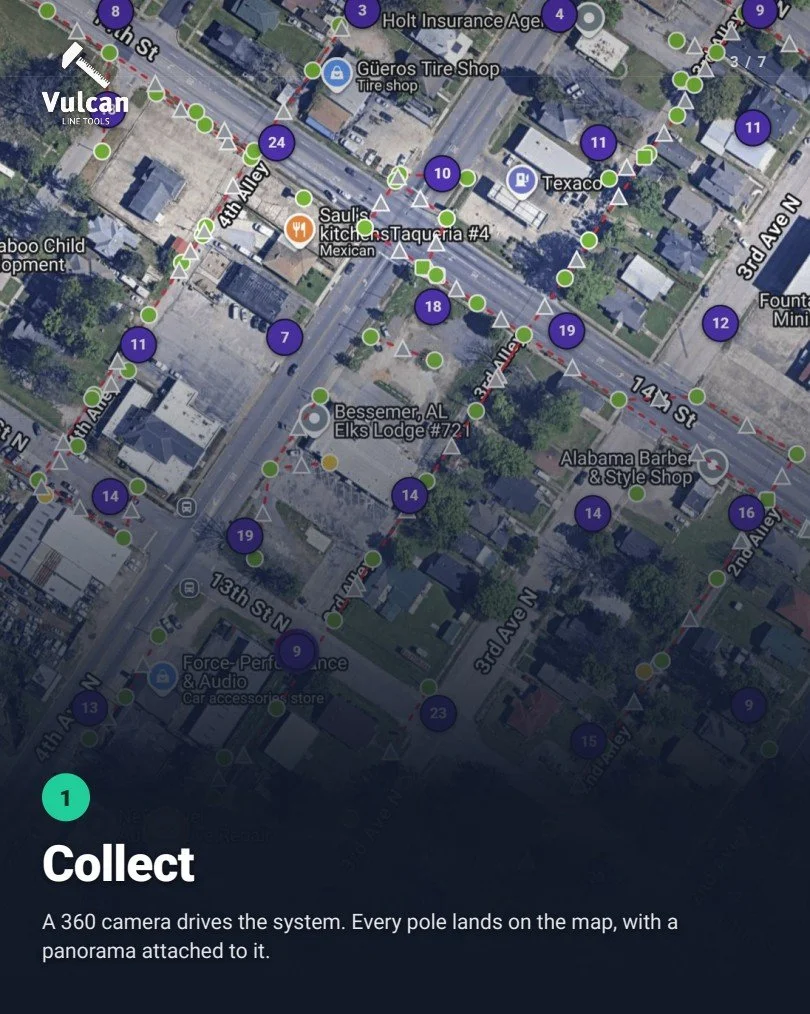
In the first step, we drive a 360° camera mounted on a truck through every road in the designated area, collecting high resolution imagery and RTK-corrected GPS data. Our collection rate is around 100 miles a day, meaning this process can take days or months depending on the size of the area.
Importantly, we upload field data daily to Azmyth, our proprietary software, so back-office teams can get to work immediately. A little background—Azmyth allows users to triangulate objects and take measurements in mobile and/or 360 imagery, resulting in dynamic GIS databases and exportable layers.
Extract
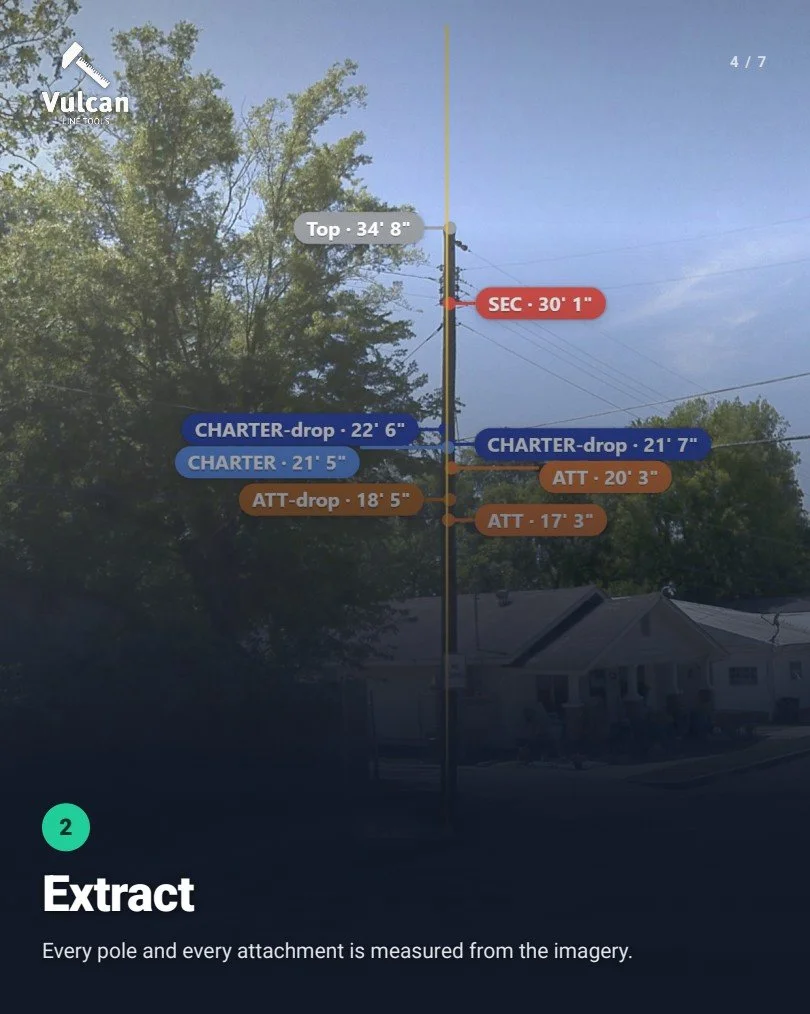
Once field data starts flowing into Azmyth, back-office teams can begin extraction. Analysts shoot poles, measure heights and call out the attachers on each pole. For BU, we also called out the lowest power attachment on each pole, important equipment like transformers and streetlights, span lengths and double wood pole locations.
Fill the Gaps
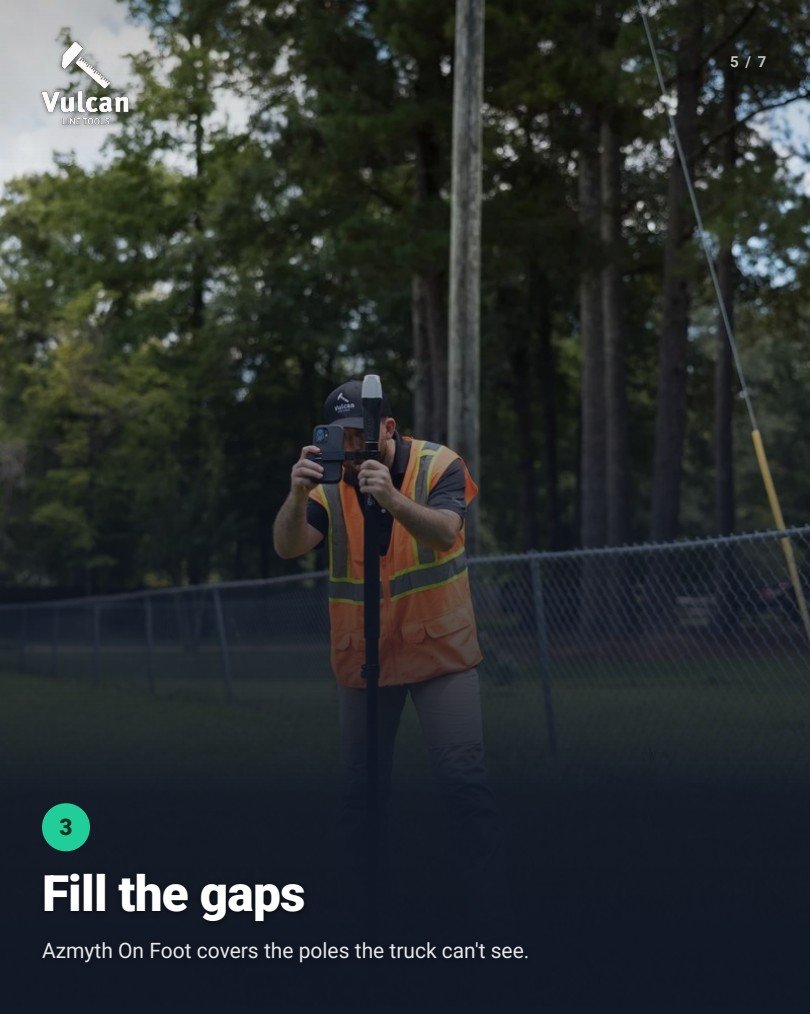
Inevitably, there are poles that cannot be seen from street-oriented imagery. We usually achieve about an 80% coverage rate from 360° imagery, but the hard-to-reach poles in backyards or wooded corridors require additional measures. In this third and final step of our process, our on-foot fielders manually collect imagery and GPS data using our mobile app, Azmyth On Foot. This app funnels instantaneously into the desktop platform, allowing back-office teams to easily fill gaps in the final deliverable while field teams are still working.
What the audit found
The final product revealed the following project statistics:
10,887 poles audited, each with a photo and a measured record
16,351 third-party attachments, recorded by owner with heights
523 double wood poles flagged
4,918 streetlights identified and mapped
The results
The success of this joint use audit lies in the value BU will realize for years to come: increased joint use revenue and improved operations.
First and foremost, we were able to identify 124% more third-party attachments than BU was previously billing for. Joint use agreements require due diligence from both the attaching party and the pole owner, and BU now has defensible records for disputes and contract renewals.
Second, BU now has benefits beyond billing like closing out double wood poles, a streetlight inventory and a GIS-ready asset map. They can now perform operations with better clarity and greater technicality.
The following are examples of data management features they now have access to in Azmyth:
Differentiate poles by unique IDs
Locate poles by coordinates
Search and sum equipment by type
Locate and sum attachments by company
View span directions and lengths.
Identify which poles and spans violate NESC clearance standards
Takeaways for other utilities
For other utilities who may be considering a joint use audit, here are a few key takeaways:
If you have not received a third-party joint use audit in the last 5 years, your attachment records are likely out of date.
If you do not possess a comprehensive GIS database of your transmission/distribution systems, your asset inventory likely contains gaps.
A joint use audit should pay for itself. If you suspect your records are out of date, it's worth finding out what an audit would uncover.
Conclusion
Bessemer Utilities is one of thousands of pole owners who have active joint use agreements with third-party attachers. From investor-owned utilities to electric co-ops and municipalities, the need to audit existing attachments is not unique to a specific organizational structure or geographic region. In BU’s case, they were unsure when their last audit had taken place, if ever, and they relied solely on the records provided to them by the attaching entities. The decision to perform a joint use audit provided them with greater visibility and safer infrastructure. Oh, and in just one year, it will pay for itself.
If you are considering a joint use audit, please check out the links below to learn more about our services.